
What Does “Against the Spread (ATS)” Mean?
If you’ve ever heard someone say a team “covered the spread,” they’re talking about betting against the spread (ATS).
In sports betting, oddsmakers set a point spread to even the playing field between two teams. Instead of just picking which team will win outright, the spread gives the underdog extra points and takes points away from the favorite.
For example:
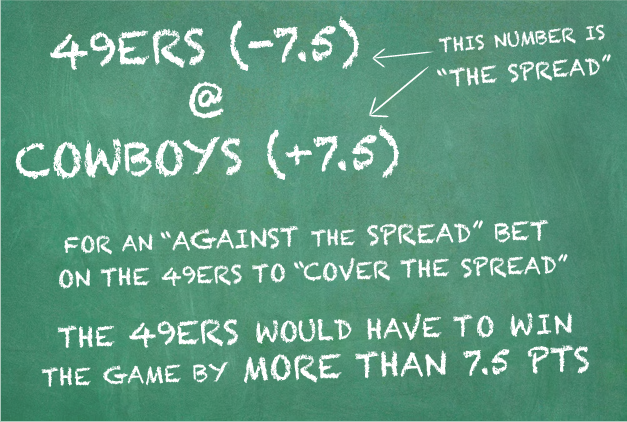
San Francisco 49ers -7.5 vs. Dallas Cowboys +7.5
If you bet the 49ers ATS, they need to win by 8 or more points for your bet to cash.
If you bet the Cowboys ATS, they can either win outright or lose by 7 points or fewer and you still win.
This system keeps games competitive for bettors, even if the matchup looks lopsided on paper.
How to tell if a bet covered the spread
- After you get the hang of it, betting on the point spread will be second nature – and it adds a fun layer to watching the game (“if the niners get a field goal here, they’ll cover!”).
- But, until you get the hang of it, a simple way to check if your team covered the spread is to adjust the final score using the point spread:
If you bet on the favorite: subtract the point spread from their final score.
If you bet on the underdog: add the point spread to their final score.
After you do that math, compare the adjusted scores:
If your team wins after the adjustment, then your bet was successful — your team “covered.”
If your team loses after the adjustment, your bet didn’t cover.
Example:
- You picked the 49ers (-7.5) against the Cowboys.
- Final Score: 49ers 28, Cowboys 24
Since you bet on the 49ers (-7.5), subtract 7.5 from the 49ers final score of 28. Result: 49ers = 20.5
Looking at the adjusted score after this calculation we see: 49ers 20.5, Cowboys 24.
The bet on the 49ers did not cover.
You lose your ATS bet, even though the 49ers won the game.
Why ats matters
“Against the spread” records (ATS records) show how often a team covers, not just how often they win. Many fans follow ATS standings closely, since a team that wins games but fails to cover might be overrated in betting markets.
It’s also important to understand that the point spread itself isn’t fixed. Sportsbooks often adjust the point spread (“move the line”) based on betting trends. If too much money comes in on one side, the spread may shift to encourage more balanced action on the other.
This matters because sportsbooks want even distribution of bets on both teams. That way, no matter who wins, the book still profits from the commission built into every wager, known as the juice (or vig).
So, while bettors focus on whether a team covers the spread, sportsbooks focus on setting (and adjusting) spreads to keep the money balanced.

What Is a Push?
Sometimes the final score lands exactly on the point spread. In that case, the result is called a push.
Example: Patriots -3 vs Jets +3
Final Score: Patriots 27, Jets 24
The Patriots win by exactly 3 points — right on the spread.
When there’s a push:
No team “covers.”
Bettors get their original wager amount refunded (no win, no loss).
In All Chalk, a push is always scored as a zero: no points awarded / no points deducted
How All Chalk Uses ATS
At All Chalk, we don’t offer real-money sports betting. Instead, we simulate the excitement of picking against the spread in a free and social environment. You don’t need to beat the sportsbook, you only need to outscore your friends.
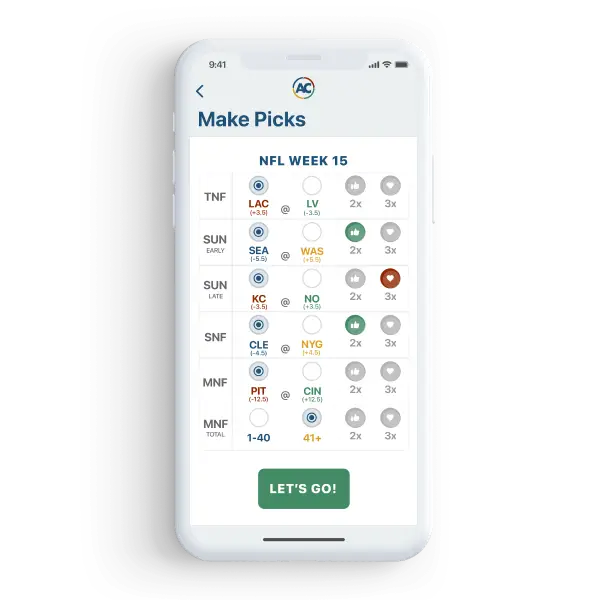
Every week, you’ll pick six NFL games against the spread.
You can “double” or “triple” your confidence on certain picks.
Scoring is simple: +1 point for a correct pick, -1 for an incorrect one.
We built All Chalk so fans can learn how spreads work and enjoy the strategy behind them—without risking real money.
FAQ
Quick
reference
guide
What does against the spread (ATS) mean?
Against the spread (ATS) is a type of sports betting where oddsmakers assign a point spread to level the playing field. Bettors win if their chosen team covers the spread, not just wins outright.
How does betting against the spread work?
A favorite must win by more points than the spread, while an underdog can either win outright or lose by fewer points than the spread. For example, a team at -7.5 must win by 8 or more, while the opponent at +7.5 can lose by up to 7 and still cover.
What is the difference between ATS and moneyline?
ATS uses the point spread to even the teams. Moneyline bets are straight picks on which team wins. Successful ATS bets typically payout close the amount wagered, since spreads balance favorites and underdogs. Moneyline bets will pay out more than amount wagered when you bet on an underdog and less than the amount wagered when you bet on the favorite.
What is a push in ATS betting?
A push happens when the final score lands exactly on the spread. In that case, no team covers and wagers are refunded.
What if the game is evenly matched?
When oddsmakers see no clear favorite, the spread is listed as a pick ’em (PK). In a pick ’em, whichever team wins the game also covers.
Why does the spread sometime change??
Sportsbooks adjust the line based on betting trends to keep money balanced on both sides. They make their profit from the commission on each bet, called the juice or vig.
What is a backdoor cover?
A backdoor cover happens when an team (typically the underdog) scores a meaningless touchdown or field goal very late in the game. Often poorly defended, these points don’t affect the outcome of the game but flips the ATS result.
Learn by doing!
Now that you know how ATS works, put your knowledge to the test in the All Chalk app. It’s free to download, free to play, and a fun way to experience betting strategy without risking money.